Singapore Solar Deployment Hits 2 GWp Ahead of Schedule: Inside the 3 GWp Plan
From 2 GWp to 3 GWp: Singapore’s Ambitious Solar Leap
Singapore has quietly become one of the world’s most solar-dense cities—remarkable for a nation with virtually no spare land. In 2025, the city-state crossed a critical threshold: over 2 gigawatt-peak (GWp) of installed solar capacity. What makes this achievement striking is the speed. Singapore added 504 MW of solar in 2025 alone, a 27% year-on-year increase, pushing cumulative capacity to roughly 2,093 MW by year-end.
Why Rooftops Became the Battleground
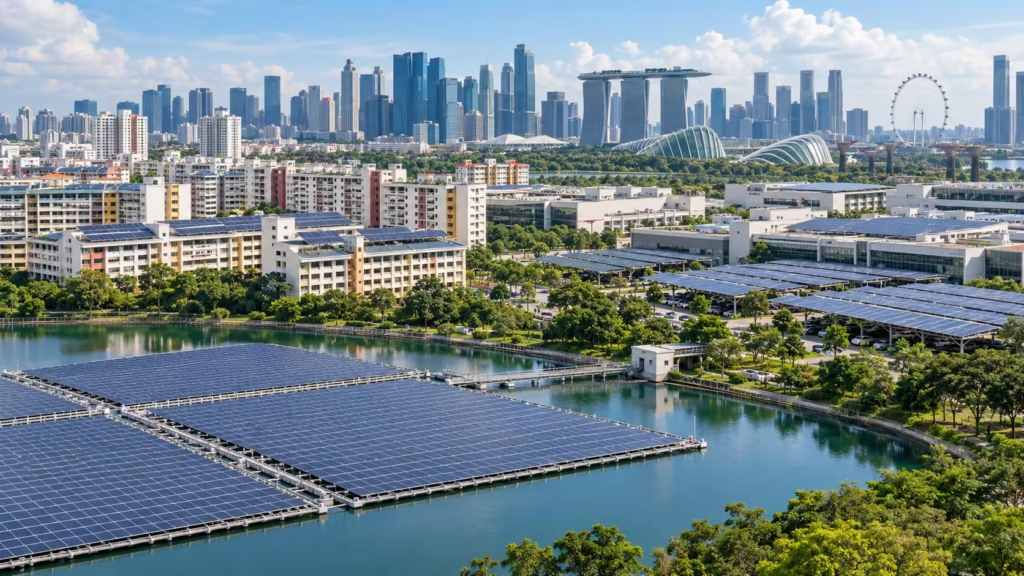
More than 80% of Singapore’s solar capacity sits on rooftops. Government-led programmes have driven this. SolarNova, led by the Housing & Development Board, aggregates demand across public housing estates. JTC’s SolarRoof and SolarLand initiatives target industrial real estate. These aren’t pilot projects—they are systematic deployments at national scale.
The economics have shifted decisively. The payback period for home solar systems has fallen to as short as five years, helped by declining panel costs and innovative “rent-to-own” financing models. Building owners can also monetise Renewable Energy Certificates (RECs), turning rooftops into revenue streams.
Floating Solar: The Next Frontier
With land exhausted, Singapore has turned to water. As of September 2026, the nation has deployed 63 MWp of floating solar systems across its reservoirs, with plans for an additional 350 MWp at Lower Seletar, Pandan, and Kranji reservoirs by 2030. These installations don’t compete with housing, industry, or transport.
The 3 GWp Target and What It Means
In Budget 2026, Singapore raised its 2030 solar target from 2 GWp to 3 GWp. At full deployment, 3 GWp will generate approximately 2,800 GWh annually—enough to power half a million households. Mr Puah Kok Keong, Chief Executive of the Energy Market Authority, framed it plainly: “Singapore is already one of the world’s most solar-dense cities, but we can do more”.
Key data point: Singapore’s solar capacity reached 2,093 MW by end-2025, with 3 GWp targeted by 2030. Source: Energy Market Authority (EMA) 2026 report.
The challenge ahead is space. Every feasible rooftop, reservoir, and even open-air car park canopy will need to be tapped. Singapore’s solar story is not about vast deserts—it is about precision engineering in a dense urban fabric.